
Starlink is a satellite internet constellation developed by SpaceX, the private aerospace and space transportation company founded by Elon Musk. The project aims to deliver high-speed, low-latency broadband internet worldwide, with a focus on reaching underserved and remote areas that lack reliable connectivity. While fiber internet generally offers higher maximum and median speeds with significantly lower latency, providing a more stable connection, Starlink brings internet access to regions where fiber installation is not feasible.
According to information from the Starlink website, the company now offers kit rentals across Kenya. Customers can rent the Starlink kit for Ksh 1,950 (USD 15) per month or purchase it for Ksh 45,500 (USD 350). Initially, the high cost of the hardware kept Starlink out of reach for many potential users, but this new rental option makes the service more accessible. As more Kenyans adopt Starlink, this move is likely to challenge local providers like Safaricom and Airtel. Starlink offers a 30-day trial period with no contract commitments, and the kit ships within a week.
As of August 2024, the residential package in Kenya costs Ksh 6,500 (USD 50) per month for unlimited high-speed, low-latency internet. The hardware is priced at Ksh 45,500. The roam package, which includes unlimited mobile data, portability, and a pause service feature, is priced at Ksh 14,000 (USD 108) per month, with a one-time hardware cost of Ksh 377,000 (USD 2,905). Additionally, Starlink offers high-speed internet for businesses starting at Ksh 8,000 (USD 61) per month, with the same hardware cost of Ksh 45,500.
Starlink entered the Kenyan market in July 2023. Initially, there was skepticism about the availability of affordable internet, especially with competition from local providers like Safaricom, Wananchi Group, and Jamii Telecommunication. The Starlink hardware kit was initially priced at Ksh 89,500 (USD 690), including installation costs. However, the technology’s primary advantage is its ability to provide service in areas where terrestrial solutions are impractical, such as parts of North Eastern Kenya and Turkana County.
When the launched in July 2023, it had only 405 subscribers. Within two months, that number had more than tripled to 1,360. By March 2024, the number of satellite internet users had grown to over 4,850. This growth is expected to continue as Starlink’s affordability and high-quality products drive market penetration and adaptability.
Features of Starlink Internet
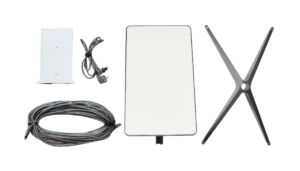
It consists of thousands of small satellites in low Earth orbit (LEO), forming a large satellite network or “constellation.” These satellites orbit at altitudes between 340 km and 1,200 km, much lower than traditional geostationary satellites, which orbit around 35,000 km above Earth. This lower orbit reduces internet latency. Starlink customers use a user terminal, commonly called a “dish” or “antenna,” which is a small, flat dish equipped with phased array technology to communicate with the satellites. The dish is self-orienting, automatically adjusting its position to connect with the optimal satellites.
Starlink offers global coverage, aiming to provide internet access in areas where traditional fiber or cable infrastructure is unfeasible. The service is particularly valuable in rural and remote regions with limited or no internet access. Starlink delivers internet speeds ranging from 50 Mbps to 500 Mbps, with latency as low as 20-40 milliseconds. Speeds and performance may vary depending on location, network congestion, and the number of users.
Starlink began its public beta program, “Better Than Nothing Beta,” in late 2020, allowing users in select regions to try the service. The service is now available in many countries, with ongoing efforts to expand coverage further.
Challenges and Criticisms
The cost of acquiring Starlink service has been a point of contention in many countries. The cost typically includes an upfront fee for the user terminal and installation, along with a monthly subscription fee for the internet service. As of 2024, the average monthly cost is around $110, with an upfront equipment fee of about $599.
While Starlink has been praised for its potential to bring internet to remote areas, it faces challenges such as the high cost of user terminals, potential interference with astronomical observations, and the environmental impact of launching thousands of satellites. Concerns about space debris also exist, as the large number of satellites increases the risk of collisions in orbit.
Kit Rental Option
The introduction of a rental kit option in Kenya makes Starlink’s satellite internet services more accessible. Initially, customers had to make an upfront payment of nearly Ksh 89,000 (USD 690) for the kit, which has since been reduced to Ksh 45,500 (USD 350) as Starlink expanded distribution through local retail chains. The new rental option provides access to a 50 GB monthly data plan with speeds up to 200 Mbps, challenging local providers like Safaricom, which offers similar packages at nearly double the price. An unlimited monthly data plan is also available for Ksh 6,500 (USD 50).
As internet access, reliability, and affordability become essential for livelihoods and businesses, customers are turning to the most viable options. It aims to meet this need by offering high-speed, low-latency internet services and continually easing the adoption of its services. The company is increasingly popular as its offerings continue to provide quality internet access to all.
Future Plans
SpaceX plans to continue launching more satellites to improve service quality and expand coverage. The ultimate goal is to have tens of thousands of satellites in orbit, providing consistent, global high-speed internet access. Despite the challenges, Starlink represents a significant step forward in global internet connectivity, offering a potential solution to bridging the digital divide in underserved and remote regions worldwide.